
The Data Dividend: Strengthening Results-Based Funding Through Data Integrity
Andrew Armstrong, Meleesa Naughton, Finan Trethewey, Kristina Nilsson, Duncan McNicholl and Rob Hope - May 2025 | Uptime Global
Applying a data integrity methodology to deliver better value for results-based funding for safe drinking water services
Results-based funding offers a transparent and cost-effective approach to improving rural drinking water services by linking financial payments to independently verified performance. However, the effectiveness of this approach depends on the accuracy and credibility of reported results.
The Data Dividend, published by Uptime Global in May 2025, examines how a practical and scalable data integrity methodology can strengthen accountability, reduce the risk of misallocated funding and support sustainable investment in safe and reliable drinking water services.
Drawing on Uptime's experience across Africa, Asia and Latin America, the paper demonstrates how robust performance monitoring can improve value for money while supporting the expansion of results-based financing.
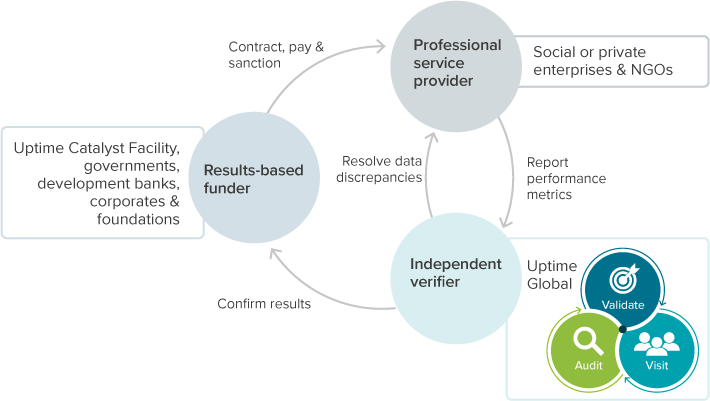
Uptime's Data Integrity Methodology
Uptime's methodology combines standardised performance metrics with quarterly data validation and annual independent verification.
1. Measuring service performance
Uptime's results-based contracts link payments to four key performance areas:
Reliability: The proportion of time that drinking water infrastructure is operational and available to users.
Water volume: The quantity of water delivered to users.
Local revenue: Payments collected from water users to support service costs.
Water safety: Sanitary inspections, water quality testing, reporting and management actions.
Service providers collect and report this information using maintenance records, financial transactions, meter readings and water quality assessments. Data collection methods can range from paper-based records to automated sensors and digital monitoring platforms.
2. Quarterly data validation
Every quarter, Uptime validates reported performance data against historical records and agreed contractual requirements.
Standardised reporting templates and automated checks identify missing information, duplicate records, unusual results and inconsistencies. Service providers must explain and resolve significant discrepancies before payments are approved.
This process helps identify potential reporting errors early and reduces the number of discrepancies requiring more detailed investigation.
3. Annual independent verification
Annual verification complements quarterly validation through two activities:
Data audits: A sample of reported results is checked against supporting documentation, including maintenance logs, meter readings, financial records and water quality assessments.
Site visits: Independent inspections and interviews with water users and operators provide additional evidence of actual service performance.
Together, these processes help identify discrepancies between reported and observed performance, while providing opportunities to strengthen service providers' data management systems.
Key Findings
The paper identifies several important findings from Uptime's experience implementing results-based contracts.
Data integrity can be achieved cost-effectively
The combined costs of validating, verifying and issuing results-based payments are less than 9% of the total contract value on average across Uptime's global portfolio.
This demonstrates that credible performance verification can be achieved without requiring expensive or complex real-time monitoring systems.
Better data improves funding decisions
Reliable performance data reduces uncertainty for governments, funders and investors. By demonstrating whether water services are delivering agreed outcomes, the methodology helps direct financial resources towards effective service provision.
It also provides evidence to inform future infrastructure investment, financial planning and service delivery improvements.
Digital innovation can strengthen verification
The paper explores the use of artificial intelligence to support data audits, particularly when reviewing large volumes of maintenance records, receipts, meter readings and other supporting documentation.
AI-assisted processes have the potential to improve efficiency and expand the volume of records that can be reviewed, while maintaining human oversight and traceable audit decisions.
Applying the Methodology at Scale
The paper examines three applications of Uptime's data integrity approach:
Government financing: In Bangladesh and Zambia, results-based contracts provide a mechanism for governments to finance professional operation, maintenance and water safety services in rural schools and healthcare facilities.
Development banks: Standardised performance data can help inform infrastructure investment decisions, estimate future revenue and design sustainable financing arrangements for rural water services.
Corporate water stewardship: Independently verified results provide companies with credible evidence of drinking water benefits generated through their financial commitments, including quantified volumetric water benefits.
These applications demonstrate how a common data integrity framework can be adapted to different funding arrangements and service delivery contexts.
Conclusion
The Data Dividend demonstrates that credible, independently verified performance data is fundamental to scaling results-based funding for rural drinking water services.
By combining simple performance metrics with practical validation and verification processes, Uptime provides funders with greater confidence in how resources are used, while strengthening accountability among professional service providers.
This approach creates opportunities to mobilise sustainable financing, improve value for money and support the delivery of safe and reliable drinking water services at scale.
Read the full publication: The Data Dividend (2025)
Related reading: How Uptime's results-based funding model works